



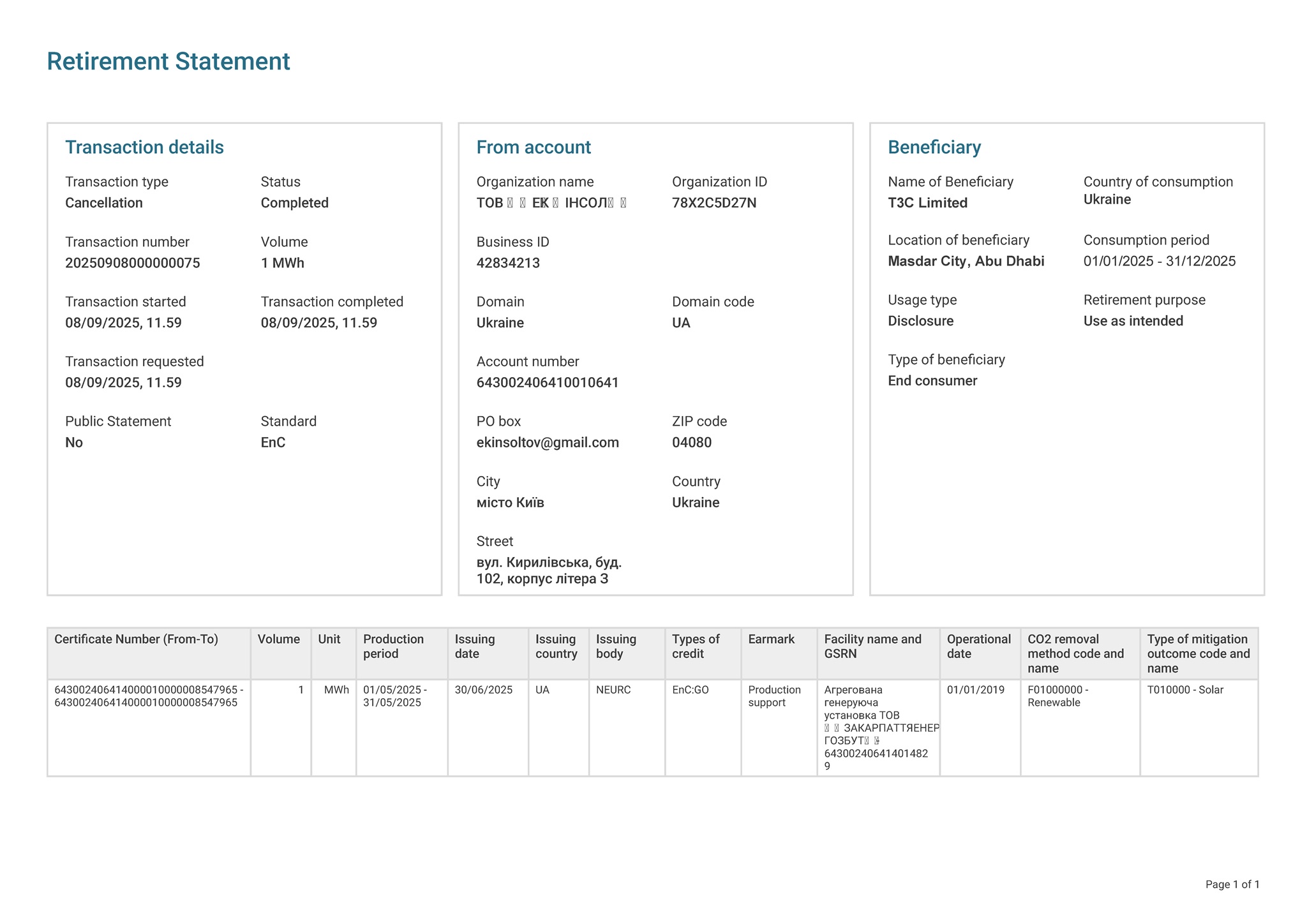
GO Certificate
A guarantee of origin (GO) certificate is an electronic document that proves a specified amount of energy, typically 1 megawatt-hour (MWh), was produced from a renewable source. It functions as a "birth certificate" for the energy, detailing where and how it was generated, and prevents the "double marketing" of renewable attributes by ensuring that a certificate is sold only once. Purchasing these certificates allows consumers, such as companies, to verify that the electricity they use comes from renewable sources, supporting their sustainability goals.
How it works
- Issuance: For every MWh of renewable energy fed into the grid, a certificate is issued by an authorized body.
- Tracking: The certificate tracks the energy's origin from production to the consumer, detailing its source and type.
- Trading: The certificates are electronically transferable documents that can be bought and sold independently of the physical electricity.
- Cancellation: To prevent double-counting, the certificate is canceled or retired after the energy has been delivered to a final customer.
Key functions
- Proof of origin: It provides proof that the electricity consumed comes from a renewable source, such as wind, solar, or hydro power.
- Transparency: It ensures transparency in the energy market, allowing consumers to see the specific origin of their renewable energy.
- Market tool: It is a crucial tool for companies that want to demonstrate their commitment to using renewable energy, which can improve their image and meet sustainability targets.
- Support for renewable energy: By creating a market for renewable attributes, GoOs encourage further investment in and development of renewable energy generation.
I-REC Certificate
"I-REC" stands for International Renewable Energy Certificate. It is an international standard for tracking and verifying the generation and consumption of renewable electricity outside of North America and Europe, where other systems such as RECs and Guarantees of Origin (GoOs) are common.
Function: Each I-REC represents one megawatt-hour (1 MWh) of renewable electricity and provides information about how, where, and when it was produced.
Purpose: It serves to demonstrate the consumption of renewable electricity and to help companies achieve their sustainability goals, such as meeting net-zero targets
Scope of application: The system is used in over 60 countries in Asia, Oceania, Africa, South America and Central America.
Convert GO Certificate to I-REC Certificate
You cannot directly "convert" a European Guarantee of Origin (GO) certificate to an International Renewable Energy Certificate (I-REC), as they are independent and region-specific systems certifying renewable energy attributes for different markets. However, you can achieve a similar outcome by first retiring the GO and then generating and issuing a new I-REC for the same amount of renewable energy from a project that meets I-REC eligibility criteria, ensuring no double counting occurs.
Here's a step-by-step approach:
1. Understand the Systems:
GOs are for the European market, while I-RECs are the international standard recognized globally
2. Identify the Project:
The renewable energy generation project that the GO was issued for must be eligible for I-REC certification
3. Verify No Double Counting:
You cannot claim the same megawatt-hour (MWh) of renewable energy under both systems, so the GO must be retired before the I-REC can be generated
4. Find an I-REC Issuer:
Locate a certified I-REC issuer in the relevant country or region where the energy is generated.
5. Issue a New I-REC:
The project will need to go through the I-REC generation process to issue new certificates for the renewable energy produced, ensuring it meets all criteria under the International Tracking Standard Foundation.
For more information about purchasing GO certificates, please contact us by email: info@t3c.ae